Quick answer
An evening routine for stress is a short set of calm steps done in the same order each night: dim the lights and park the phone, brew a caffeine-free herbal tea such as chamomile, write a 3-line brain dump, stretch gently, breathe slowly (in for 4, out for 6) and go to bed at the same time.
Key facts
- Start 60 to 90 minutes before bed
- Brew 1 to 2 teaspoons of dried herb per 250 ml cup, covered, 5 to 10 minutes
- Slow breathing: in for 4, out for 6, for about 4 minutes
- Skip chamomile if you react to ragweed or daisies
- Ask a pharmacist first if you take medicines or are pregnant
An evening routine for stress is a short, repeatable set of steps you do in the same order each night, so your body gets a clear signal that the day is over. Ours takes about 60 minutes and uses five simple tools: lower light, a caffeine-free herbal tea, a few lines on paper, gentle movement and slow breathing.
None of this replaces care from a professional. Still, small habits done every night are where most people feel the difference first, and an evening routine for stress costs nothing to try.
Why an evening routine for stress works
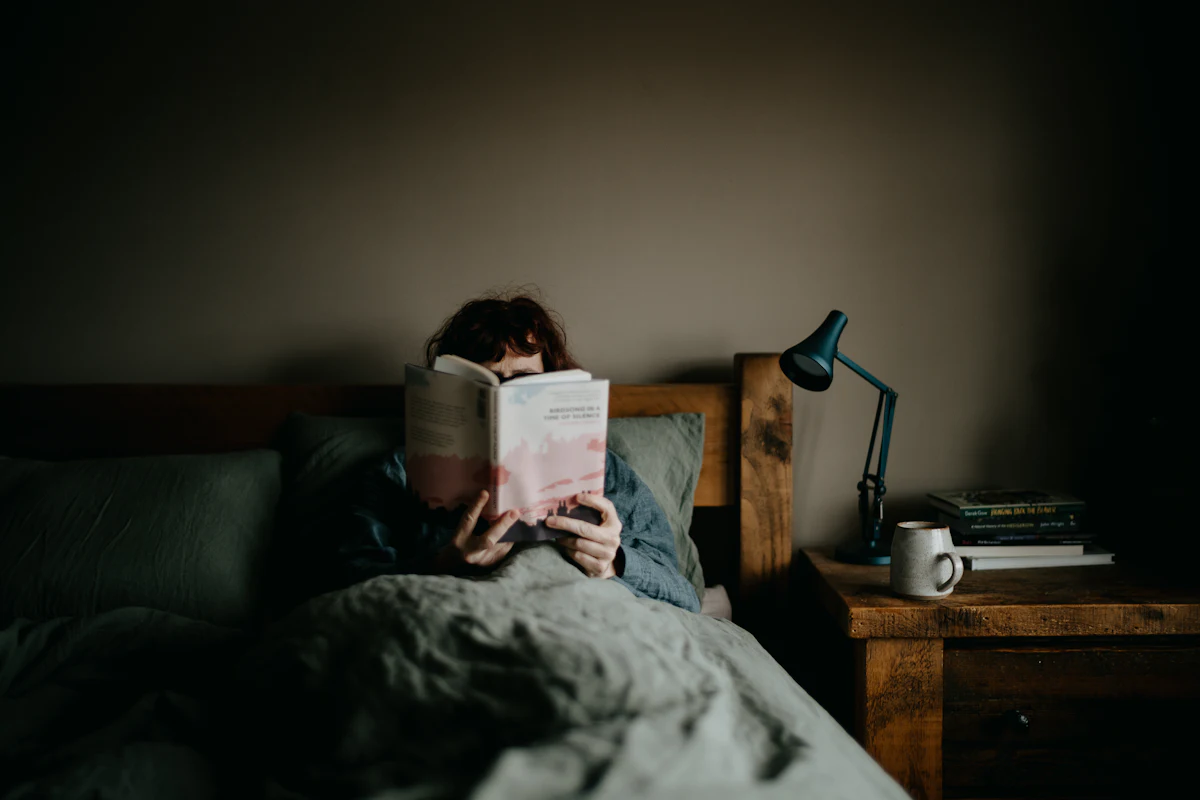
Stress rarely switches off on its own at bedtime. Instead, the mind keeps running the day’s list while the body stays on alert. A routine helps because it removes decisions: you no longer ask “what now?”, you simply do the next step.
In addition, repetition builds a cue. After a week or two, the first step (dimming the lights, say) starts to feel like the beginning of rest. That is the whole idea behind an evening routine for stress: the same calm steps, in the same order, at roughly the same time.
What the research says, in plain words
The U.S. National Center for Complementary and Integrative Health notes that relaxation techniques such as slow breathing are generally considered safe for healthy people, and small studies link deep breathing with lower self-reported stress. The evidence is modest, so we use these steps as gentle habits, not as therapy.
For herbal tea, the honest picture is similar. Chamomile is one of the most studied calming cups, yet NCCIH describes the research on chamomile for anxiety as early and preliminary. So we enjoy the cup as a warm ritual first, and we keep expectations realistic.
The Herbal Kitchen Bundle
Know it, brew it, grow it: 6 herbal kitchen products with a 30-day path, from your herb shelf to your own garden.
- EbookThe Herbal Remedy Shelf
- EbookHerbal Teas for Every Day
- EbookGrowing Your Own Herb Garden
- PrintableHerb Guide Chart
- PrintableTea Blend Recipe Cards
- PrintableHerb Garden Planner


The 7-step evening routine for stress at a glance
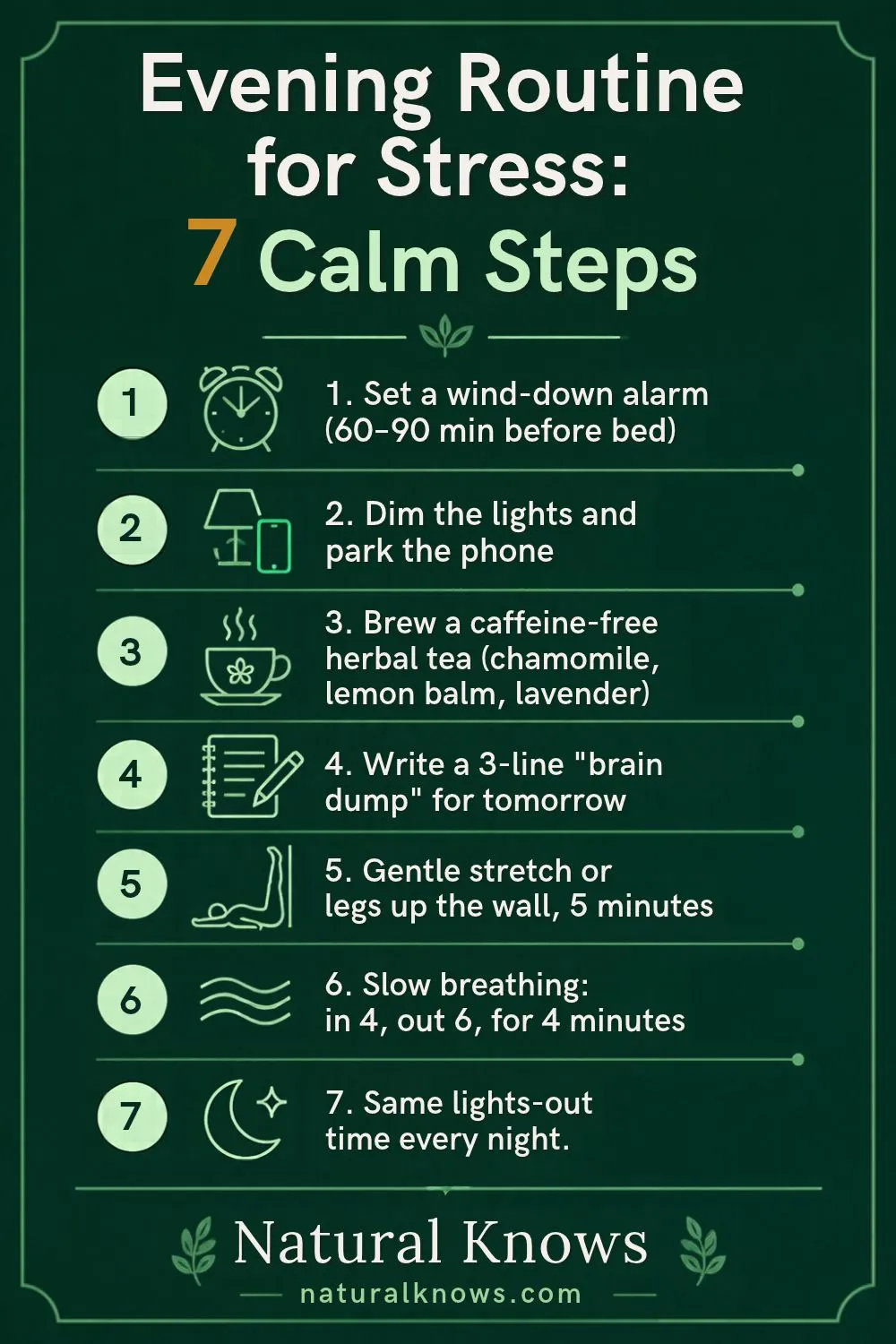
Here is the full evening routine for stress on one screen. Start 60 to 90 minutes before you want to be asleep.
| Step | What you do | Time |
|---|---|---|
| 1. Wind-down alarm | A soft phone alarm tells you the evening has started | 1 min |
| 2. Low light, phone parked | Dim lamps, phone charging outside the bedroom | 2 min |
| 3. Herbal tea | Brew a caffeine-free cup, covered | 10 min |
| 4. Brain dump | Write 3 lines: what’s done, what’s next, one worry | 5 min |
| 5. Gentle stretch | Legs up the wall or a slow forward fold | 5 min |
| 6. Slow breathing | Breathe in for 4, out for 6 | 4 min |
| 7. Same lights-out time | Bed at your usual time, every night | — |
Step 1 and 2: light and screens in your evening routine for stress
First, set a wind-down alarm. It sounds silly, but most of us do not “notice” evening until it is already late. A gentle alarm 60 to 90 minutes before bed marks the start.
Next, lower the light. Switch off the big ceiling light and use one or two warm lamps instead. Then park your phone on a charger outside the bedroom, or at least across the room.
- Swap the ceiling light for a warm table lamp
- Turn on night mode on every screen you still use
- Put the phone on charge out of reach of the bed
- Keep a paper book or a magazine for the last half hour
Shortcut vs source: the shortcut is scrolling until you feel sleepy. The source is giving your eyes and mind less to react to, which is exactly what low light and a parked phone do.
Step 3: the herbal tea part of your evening routine for stress
A warm cup is the heart of our evening routine for stress. Choose a caffeine-free herbal tea and keep green and black tea for the morning, because both contain caffeine.
To brew, use 1 to 2 teaspoons of dried herb (or one tea bag) per 250 ml cup of just-boiled water. Then cover the cup while it steeps for 5 to 10 minutes, so the aromatic oils stay in your tea and not in the steam.
| Tea | Taste | Steep | Good to know |
|---|---|---|---|
| Chamomile | Soft, apple-like | 5–10 min, covered | Skip it if you react to ragweed or daisies |
| Lemon balm | Light, lemony | 5–10 min, covered | Mild flavour, mixes well with chamomile |
| Lavender | Floral, strong | 3–5 min | Use only ½ teaspoon; it turns bitter fast |
| Passionflower | Grassy, mild | 10 min | Ask a pharmacist if you take sedative medicines |
| Rooibos | Sweet, nutty | 5–7 min | Naturally caffeine-free, good with a splash of milk |
Our full guide to the best teas for anxiety compares seven calming cups side by side. If you like to blend your own, the herbs and teas section has more ideas.
Two simple evening blends
- Calm cup: 1 teaspoon chamomile + 1 teaspoon lemon balm, covered, 8 minutes
- Cozy cup: 1 rooibos bag + a pinch of lavender (about ¼ teaspoon), 6 minutes
Store dried herbs in a closed jar away from light and heat, and use them within about a year for the best flavour.
Step 4: a 5-minute brain dump
Many stressful evenings are really “unfinished list” evenings. So, while your tea cools, take a notebook and write three short lines.
- What I finished today (one thing is enough)
- The first task for tomorrow
- One worry, written down so it can wait until morning
This takes five minutes. Afterwards, close the notebook and leave it outside the bedroom. As a result, the list has a place to live that is not your head.
Step 5: gentle movement before bed
Next, move a little, slowly. Hard workouts late at night can leave some people more alert, so keep this part soft and short.
- Legs up the wall: lie on your back with your legs resting on the wall, 3 to 5 minutes
- Seated forward fold: sit with legs straight and fold forward gently, knees soft
- Child’s pose: kneel, sit back on your heels and rest your forehead down
For a longer sequence, see our yoga poses for anxiety relief. Stop any pose that hurts, and ask a professional first if you have back, hip or knee problems.
Step 6: slow breathing in your evening routine for stress
Breathing is the quickest step of the evening routine for stress, and you can do it in bed. Breathe in through your nose for a count of 4, then breathe out slowly for a count of 6. Repeat for about 4 minutes.
A longer out-breath feels calming for many people. If counting makes you tense, just make each out-breath a little slower than the in-breath.
Our free calm breathing pattern tool paces the counts for you on screen. You will also find more methods in breathing exercises for stress and a short guide to meditation for anxiety relief.
Step 7: the same lights-out time
Finally, go to bed at about the same time each night, weekends included where you can. In fact, consistency is what turns seven separate habits into one evening routine for stress your body learns to expect.
If you lie awake for a long time, get up, keep the lights low, and repeat the breathing step in a chair before trying again.
A sample evening timeline (bed at 11 pm)
Times are only an example; shift them to your own bedtime. The point is the order, not the clock.
| Time | Step |
|---|---|
| 9:30 pm | Wind-down alarm rings; ceiling light off, one lamp on |
| 9:35 pm | Phone on charge in the kitchen |
| 9:40 pm | Kettle on, herbal tea brewing with a lid |
| 9:50 pm | Brain dump in the notebook while the tea cools |
| 10:00 pm | Tea, a warm shower or a few pages of a paper book |
| 10:35 pm | Five minutes of gentle stretching |
| 10:45 pm | Four minutes of slow breathing in bed |
| 11:00 pm | Lights out |
On a late night, keep only three steps: low light, the cup of tea and the breathing. A short evening routine for stress done often beats a perfect one done twice a month.
6 common mistakes that undo a calm evening
Most routines fail for small, fixable reasons. Here are the ones we see most often, with the simple swap for each.
- Caffeine after mid-afternoon: switch to a caffeine-free herbal tea or rooibos after lunch.
- Email “just one last time”: set the wind-down alarm and see it as the end of the work day.
- Bright overhead lights until bedtime: move to one warm lamp at the start of the routine.
- A huge cup of tea at 10:55 pm: drink your cup earlier so you are not up in the night.
- Doing every step perfectly or not at all: on busy nights, keep three steps and let the rest go.
- Changing the order every night: the same order is what makes it a cue, so keep it fixed for two weeks.
Optional extras: scent, food and a warm bath
These are add-ons, not musts. Pick one at a time and keep what you enjoy.
A diffuser with lavender
Two to three drops of lavender oil in a water diffuser for 20 to 30 minutes is a simple scent cue. Never apply essential oils to skin undiluted; first read our essential oil safety guide and use the oil dilution calculator for any roller blend. Our list of essential oils for anxiety relief covers more options.
A lighter dinner
A heavy, late meal can make evenings feel restless. For ideas on what to put on the plate earlier in the day, see foods that reduce anxiety.
A warm bath or shower
Similarly, a warm (not hot) shower about an hour before bed feels relaxing for many people and fits right after the brain dump.
Watch: the evening routine for stress in 5 minutes
Your printable evening routine for stress checklist
Copy this list onto a card and keep it by the kettle. Tick each box for a week, then keep the steps that help.
- Wind-down alarm set for 60–90 minutes before bed
- Ceiling light off, one warm lamp on
- Phone on charge outside the bedroom
- Caffeine-free herbal tea brewed, covered
- Three lines written in the notebook
- Five minutes of gentle stretching
- Four minutes of 4-in, 6-out breathing
- Lights out at my usual time
Safety notes before you start
Who should check first: if you are pregnant or breastfeeding, take regular medicines (especially blood thinners, sedatives or hormonal birth control), have allergies to plants in the daisy family, or have a health condition, ask your doctor or pharmacist before adding herbal teas or essential oils.
When a routine is not enough: if stress or anxiety is affecting your work, sleep or relationships for weeks, or you feel unable to cope, please talk to a doctor or a mental health professional. In a crisis, contact your local emergency number.
You take daily medicine and want to start St John's wort tea. Best move?
This guide is general information, not medical advice.
FAQ
How long should an evening routine for stress take?
About 45 to 90 minutes from start to lights-out is a good range. The steps themselves take around 30 minutes; the rest is simply lower-light, low-effort time. Even 20 minutes is better than nothing on busy nights.
What is the best tea to drink before bed for stress?
Chamomile and lemon balm are the most popular caffeine-free choices, often mixed together. Rooibos is a good option if you dislike floral flavours. Avoid green and black tea in the evening because they contain caffeine.
Can I drink herbal tea every night?
For most healthy adults, one cup of a common herbal tea in the evening is a normal habit. However, rotate your herbs, and check with a pharmacist first if you take medicines or are pregnant or breastfeeding.
Is it better to do the routine in the same order every night?
Yes. Keeping the same order is what turns the steps into a cue. After a week or two, starting the first step often makes the rest feel easier.
What if I can’t put my phone away?
Start small. Put it on night mode and across the room for the last 30 minutes, then stretch that to an hour over the next weeks.
Does an evening routine for stress replace therapy?
No. A routine is a supportive habit. If stress or anxiety is persistent or severe, a doctor or mental health professional is the right next step.
Natural still needs amounts and care. Patch test new skin products, keep oils and herbs away from small children, and ask a doctor or pharmacist first if you are pregnant, breastfeeding, take medicines or have a health condition.