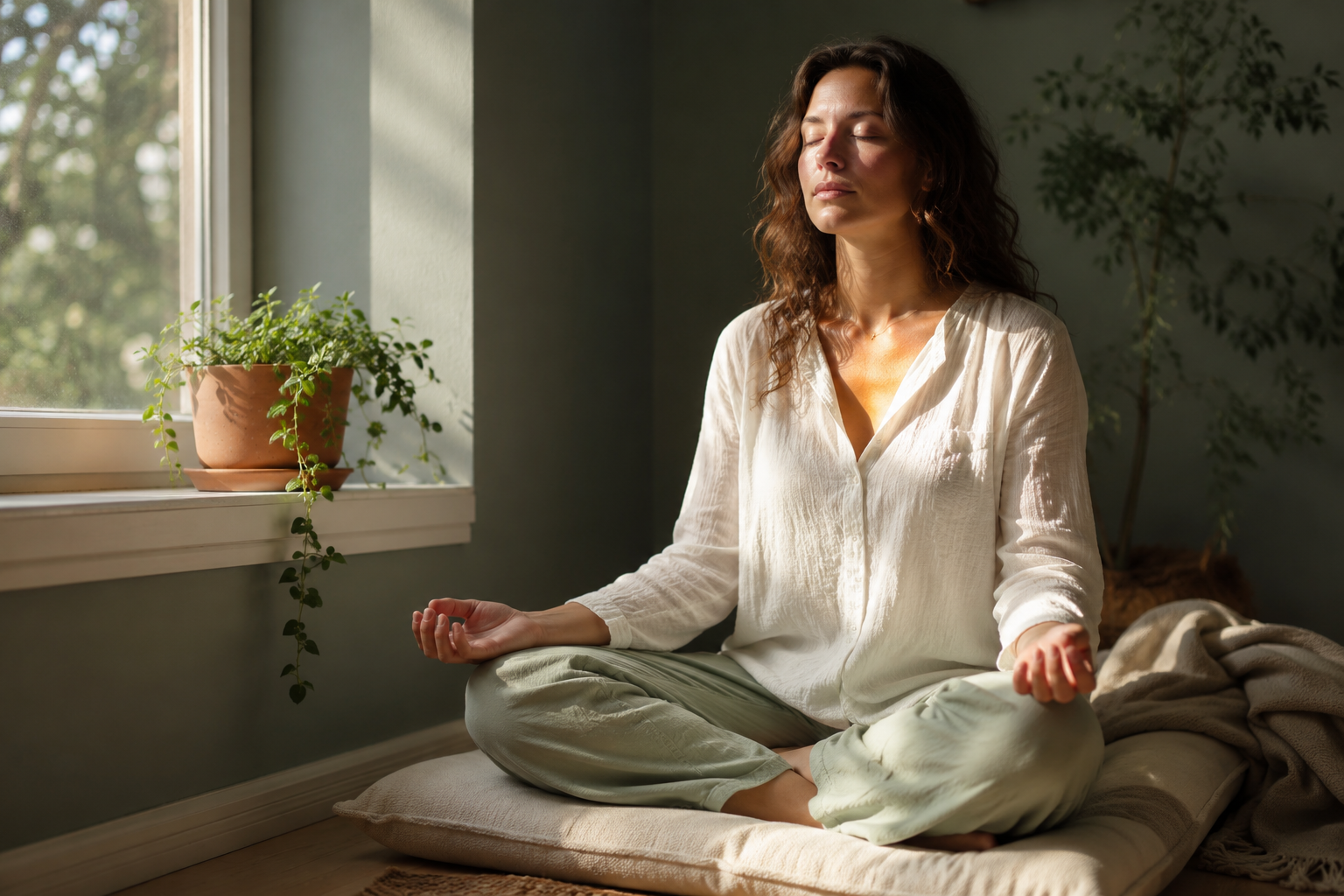
You sit down, last four minutes, and stand up more wound up than when you started. That is not a character flaw and it is not proof that meditation for anxiety relief “doesn’t work for your brain” — it is almost always a technique mismatch plus a dose problem, and both are fixable in an afternoon. This guide gives you the starting length, the matching rules, the eight-week ramp, and the honest version of what can go wrong.
Anxiety is a body-and-mind loop: a thought raises your heart rate, the raised heart rate confirms the thought, and the loop tightens. Meditation interrupts it in two places at once. Slow, exhale-led breathing pulls the physical alarm down. Repeated noticing teaches you to see a worry thought as a passing event instead of an instruction. Start at four to five minutes a day, same time, one anchor. Build to ten to fifteen minutes across eight weeks. Most people feel faster recovery from stress long before they feel calm.
Key Takeaways
Why Meditation for Anxiety Relief Works on Your Body Before It Works on Your Mind

Meditation calms the physical side of anxiety first, and the mental side follows — which is the opposite of how most beginners expect it to feel. You will not notice your thoughts going quiet. You will notice, weeks in, that your shoulders drop faster after a difficult email.
The mechanism is not mystical. A long exhale stimulates the parasympathetic branch of your nervous system — the “rest and digest” side — which slows heart rate and lowers arousal. Stanford Medicine’s David Spiegel, who co-led a controlled trial on breathing and mood, describes breath as sitting right on the edge of conscious control: mostly automatic, but you can take the wheel any time you want. That is unusual. You cannot decide to lower your blood pressure. You can decide to make your next exhale twice as long as your inhale.
The second mechanism is attentional. Anxiety runs on fusion — treating a thought as a fact. “I’m going to embarrass myself” arrives and your body responds as if it already happened. Meditation trains the gap between noticing a thought and obeying it. Every time your attention wanders and you bring it back, that is one rep. The wandering is not the failure. The wandering is the equipment.
An effect size of 0.38 deserves plain language, because it gets wildly overstated online. It means meditation moved anxiety scores by roughly a third of a standard deviation compared with an active control group — a real, moderate improvement, on par with several other established self-management tools. Not a cure. Not nothing. The same review found the benefit had faded to 0.22 by the three-to-six-month mark in people who had stopped practising, which tells you something important: this behaves like exercise, not like a vaccine.
The strongest single piece of evidence came in 2023. In a randomised trial led by Georgetown University Medical Center and published in JAMA Psychiatry, 276 adults with diagnosed anxiety disorders were assigned either to an eight-week mindfulness-based stress reduction course or to escitalopram, a standard first-line medication. Mindfulness came out non-inferior — statistically, it held its own. The side-effect gap was the headline nobody quotes: at least one study-related adverse event occurred in 78.6% of the medication group versus 15.4% of the meditation group. That is not an argument for skipping treatment. It is an argument for taking the practice seriously enough to do it properly.
💡 Tip
Read the numbers as a floor, not a ceiling. Trial participants were assigned a practice they did not choose. You get to pick the technique that fits your particular flavour of anxious — which is the single biggest lever you have.
Start at Four Minutes: The Dose That Survives Contact With Real Life
The right beginner dose is short enough that skipping it feels absurd, and the research points to a minimum effective amount rather than a maximum.
Researchers at NYU, led by Julia Basso, randomised 42 people who had never meditated into two groups: 13 minutes of daily guided meditation, or 13 minutes of daily podcast listening. After eight weeks, the meditation group showed lower anxiety, less mood disturbance and less fatigue, plus better attention and recognition memory. Here is the detail everyone skips. At the four-week checkpoint, those differences were not there yet. Eight weeks did it. Four did not.
One more number from that study is quietly useful: the meditation group averaged 5.5 sessions a week, not seven. Perfect attendance was never the mechanism. Roughly five out of seven days, sustained for two months, was enough to move the needle.
So why suggest four minutes when the trial used thirteen? Because a supervised trial participant has a research team checking in. You have a Tuesday. Starting at thirteen minutes when your baseline is zero is the meditation equivalent of booking a marathon for next month. Start below your capacity on purpose, then climb.
The Eight-Week Ramp (Print This)
| Weeks | Daily length | Focus | Move up only if… |
|---|---|---|---|
| 1–2 | 4 minutes | Showing up at the same time | You hit 5 of 7 days |
| 3–4 | 6 minutes | One anchor, no track-hopping | You hit 5 of 7 days |
| 5–6 | 10 minutes | Unguided for the final 2 minutes | You hit 6 of 7 days |
| 7–8 | 13–15 minutes | Fully unguided, timer only | Hold here for a month before adding |
Two rules keep this ramp honest. First: if you miss two days back to back, halve the length instead of skipping a third day — a two-minute sit protects the habit far better than a heroic twenty-minute make-up session. Second: never increase the duration in the same week you change the technique. Change one variable at a time or you will not know what helped.
Five Techniques, Matched to the Kind of Anxious You Actually Are
Picking a technique at random is why most people conclude meditation isn’t for them — the practice that soothes a racing mind can genuinely aggravate a racing body. Find your row, then read the instructions underneath.
| If your anxiety shows up as… | Use this | Session length |
|---|---|---|
| Looping thoughts, replaying conversations | Noting | 5–10 min |
| Tight chest, shallow breath, physical buzz | Cyclic sighing | 5 min |
| Restlessness, cannot sit still, fidgeting | Walking meditation | 8–12 min |
| Self-criticism, social dread, shame spirals | Loving-kindness | 8–10 min |
| Night-time rumination, wired-but-tired | Body scan, lying down | 10–15 min |
1. Noting — For the Mind That Won’t Stop Narrating
Sit. Breathe normally. Each time you catch your attention somewhere other than the breath, silently label it in one word — planning, remembering, worrying, rehearsing — then return. That’s the whole practice. Labelling sounds trivial and does something specific: it converts an experience you are inside of into an object you are looking at. Ten labels in five minutes is a good session. Forty labels is also a good session.
2. Cyclic Sighing — The Fastest Physical Down-Shift
Inhale slowly through the nose. When your lungs feel comfortably full, take a second, shorter sip of air through the nose to top them off. Then exhale slowly and completely through the mouth until the air runs out. Repeat for five minutes.
This one has unusually clean evidence behind it. A Stanford Medicine team including Spiegel and neurobiologist Andrew Huberman ran a randomised, fully remote trial: 111 volunteers, five minutes a day, one month, comparing cyclic sighing against two other breathing patterns and against mindfulness meditation. Every group improved. The controlled-breathing groups improved more — a daily rise in positive feeling of 1.91 points on the Positive and Negative Affect Schedule versus 1.22 for the meditation group, roughly a third better. Cyclic sighing led the pack, and it was the only condition that measurably lowered participants’ resting breathing rate throughout the day, not just during the exercise. You can read Stanford’s own write-up of the cyclic sighing trial for the full detail.
✨ Quick win
Two cycles — roughly 30 seconds — before you walk into a hard conversation, answer a dreaded call, or press send. You do not need the full five minutes to feel the drop. This is the one technique that works from a parked car.
3. Walking Meditation — When Sitting Still Is the Problem
Pick a stretch you can walk in about fifteen paces — a hallway, a garden path, a quiet pavement. Walk at roughly half your normal speed. Put your attention on the sole of each foot: the moment of contact, the roll, the lift. At the end of the stretch, pause, turn deliberately, walk back. Anxious restlessness is stored energy looking for an exit; this gives it one without letting the mind off the leash. Our guide to five yoga poses for anxiety relief pairs well with this if you want a longer movement-based option.
4. Loving-Kindness — For the Anxiety Aimed at Yourself
Sit and repeat four phrases silently, on the exhale: May I be safe. May I be well. May I be at ease. May I live with kindness. Two minutes for yourself, then two minutes directing the same phrases toward someone easy to love, then two minutes toward someone neutral — the person at the checkout, a neighbour you nod to. If the phrases feel hollow, keep going anyway. The awkwardness fades around week three, and the point is not sincerity on demand; it is repetition rewiring a default.
5. Body Scan — For 2 a.m. Rumination
Lying on your back, move attention slowly from the toes of the left foot up to the crown of the head, spending five to ten seconds in each region: foot, ankle, calf, knee, thigh, hip — then the same on the right, then torso, arms, neck, face. You are not relaxing each part. You are only noticing what is there, including nothing. Falling asleep partway through is not cheating. For an evening routine, layering this with lavender and chamomile for sleep gives you a cue the brain learns to associate with winding down.
⚠️ Warning
If you live with panic attacks, be cautious with deep sighing, breath-holding and any pattern that changes your breathing chemistry quickly — these can amplify the exact sensations that trigger panic. Start with an external anchor instead: sounds in the room, the weight of your feet, the temperature of your hands. Bring this up with a clinician who knows your history before you experiment.
From the NaturalKnows library
The Natural Reset Bundle
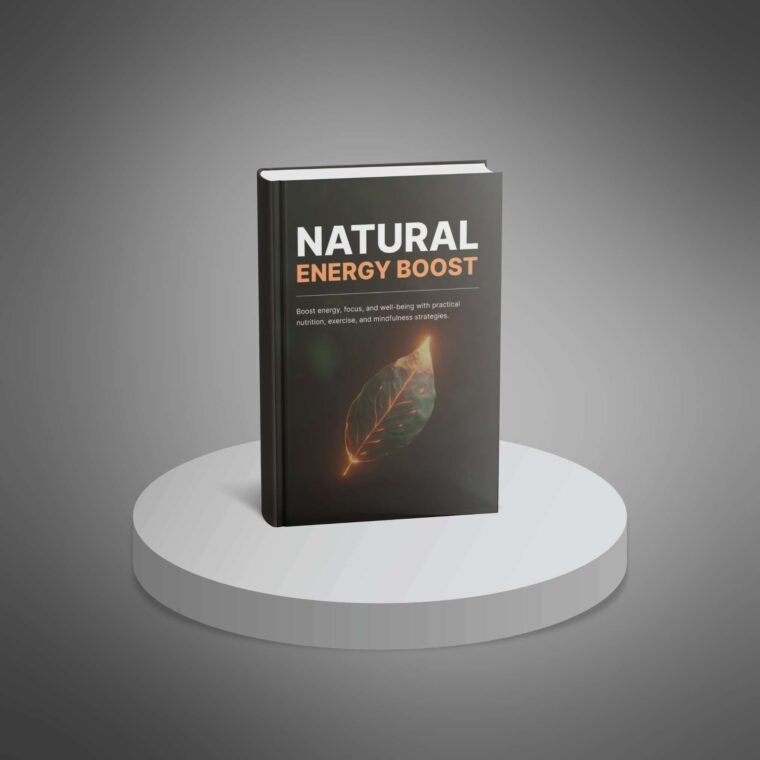
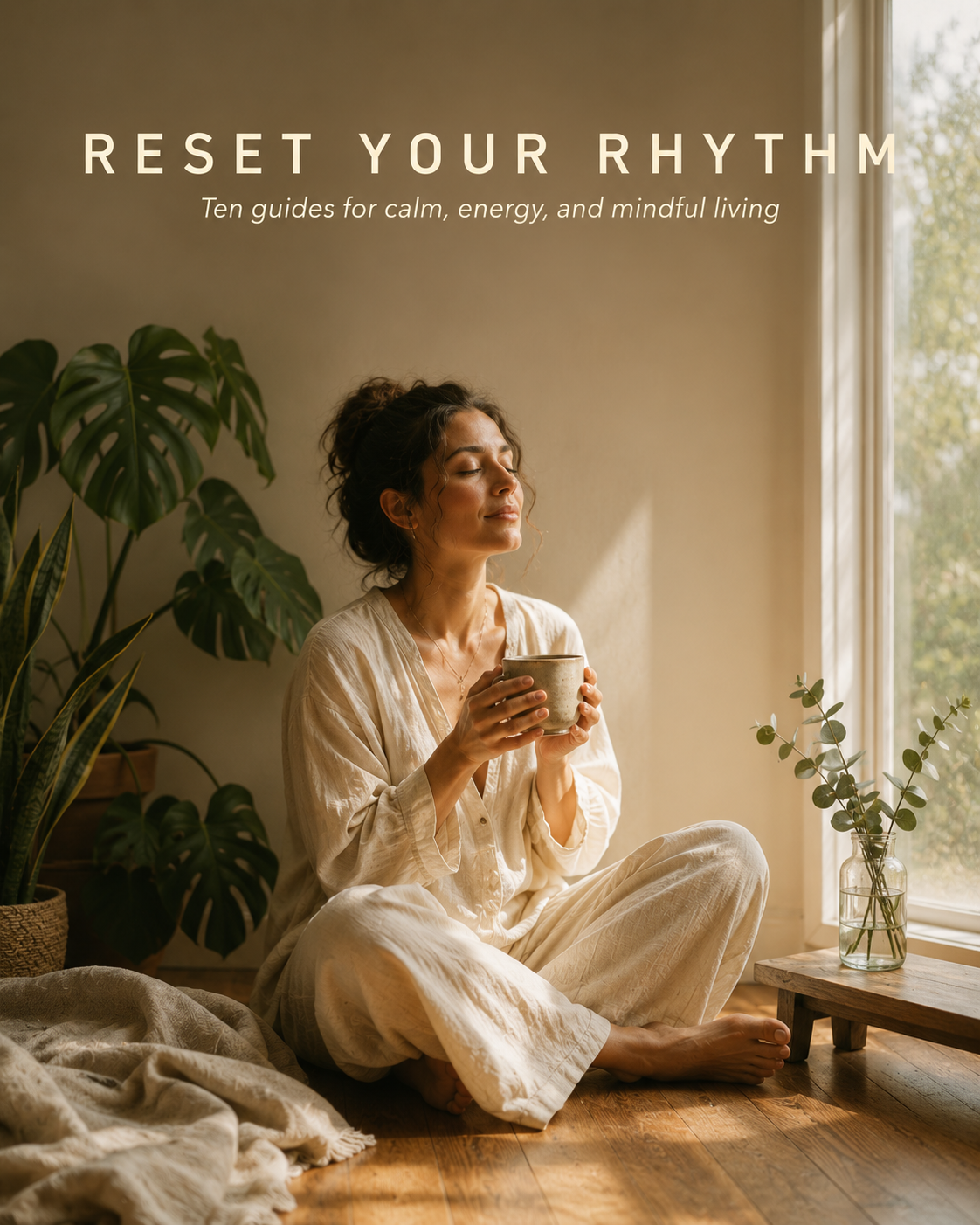
If this article is the map, the bundle is the field kit. Ten guides built around exactly this territory — including The Science of Stress Relief, Break Free from the Cortisol Cycle, Mindfulness for Everyday Life and The Power of Mindful Mornings — plus a 21-module planner you can use to run the eight-week ramp above.
- Session scripts and trackers you can print tonight
- A calmer nervous system in minutes a day, not hours
- Instant download · lifetime access · works on any device
Your Eight-Week Meditation for Anxiety Relief Schedule
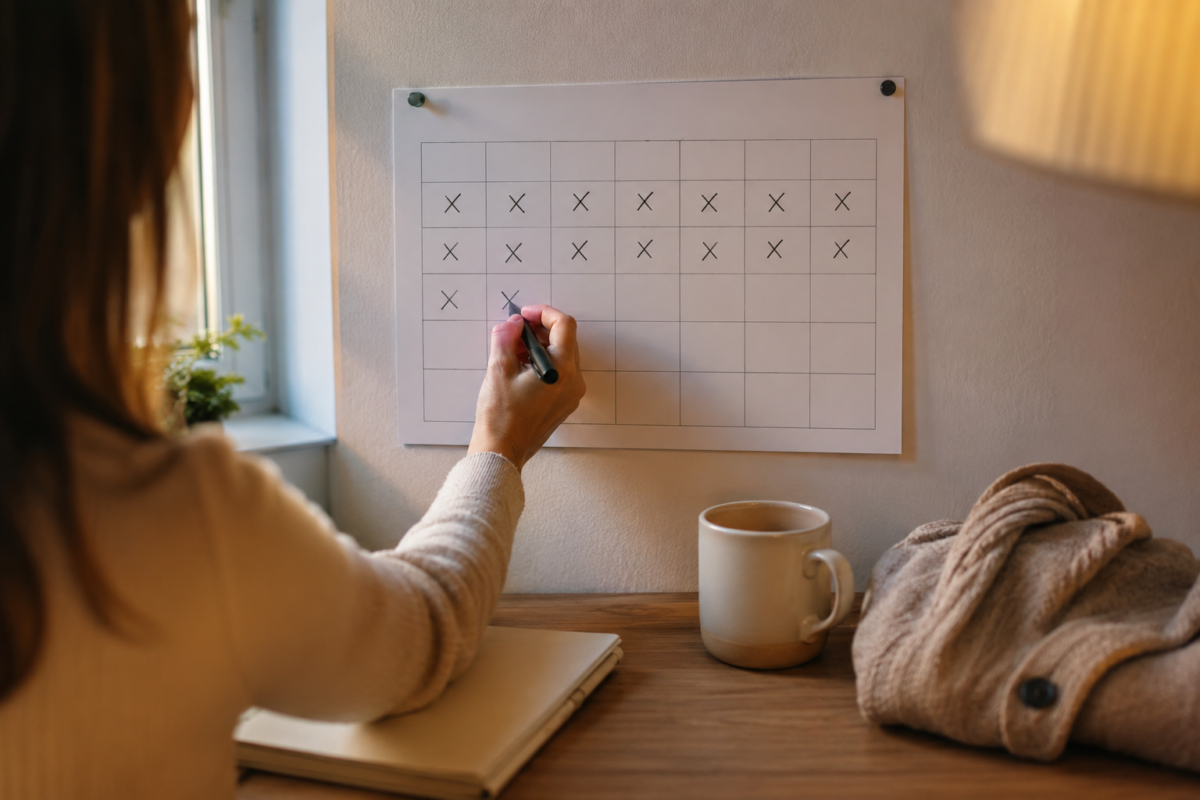
This is the ramp from earlier turned into instructions you can follow without deciding anything each morning — the deciding is what kills the habit.
Weeks 1–2 · Build the slot, not the skill
Four minutes, same time, same chair. Pick your technique from the table above and do not change it. Set a timer with a soft chime. Your only goal for fourteen days is that the slot exists — whether the session felt good is irrelevant data at this stage.
Weeks 3–4 · Six minutes, one anchor
Add two minutes. Resist the urge to sample new guided tracks — app-hopping in week three is the most common way a promising practice dies. Start noticing where your mind goes most: planning, replaying, or catastrophising. That pattern is useful information later.
Weeks 5–6 · Ten minutes, and let go of the voice
Run eight minutes guided, then stop the audio and sit for two minutes with only a timer. This is where the practice becomes portable. A guided track is training wheels; the goal is being able to steady yourself in a waiting room with no headphones.
Weeks 7–8 · Thirteen to fifteen minutes, unguided
Timer only. At the end of week eight, compare your week-one and week-eight morning ratings (see the tracking method below). Then hold this length for a month before adding anything — consolidation beats escalation.
📝 Note
Morning practice wins on adherence, not on physiology. Nothing about the nervous system prefers 7 a.m. — but a slot before the day starts making demands is the slot least likely to get eaten. If your mornings are chaos, put it immediately after work instead. Consistency of cue beats time of day every time.
When Meditation Makes You More Anxious — and Exactly What to Change
Sitting quietly with your own nervous system can stir things up rather than settle them, and this is documented well enough that pretending otherwise does readers a disservice.
A team at Brown University led by Willoughby Britton interviewed 96 people after they completed an eight-week mindfulness-based programme, using a 44-question interview conducted by someone unconnected to the teaching. Fifty-eight per cent reported at least one meditation-related adverse effect. Thirty-seven per cent reported effects that had a negative impact on daily functioning. Six per cent had impairment lasting more than a month — a rate the researchers noted is comparable to other psychological treatments, not unusually high. Their most quietly damning finding: when they asked the open-ended version of the question instead of the specific one, it underestimated the true rate by seventy per cent.
The broader picture is milder. A 2020 review of 83 studies covering 6,703 participants, summarised by the US National Center for Complementary and Integrative Health, put the figure at around eight per cent experiencing a negative effect — most often anxiety or low mood — again, roughly what you’d see with talking therapies. You can read the NCCIH’s plain-language summary of meditation effectiveness and safety, and Brown’s own account of why the risks went unmeasured for so long.
None of this is a reason to stop. It is a reason to know the four adjustments, so that a rough week reads as a signal rather than a verdict.
- Swap to an external anchor. If watching your breath makes your chest tighter, stop watching your breath. Anchor on sound instead — traffic, birds, the fridge hum — or on the pressure of your feet against the floor. Internal body-focus is the ingredient that backfires for most people, and it is optional.
- Open your eyes. Soft gaze, angled down at a spot on the floor about a metre ahead. Closed eyes amplify inner noise for anxious minds. Nothing in the practice requires darkness.
- Cut the length in half, twice if needed. Two minutes done calmly beats ten minutes endured. Distress is not the price of entry, and “pushing through” is advice borrowed from athletic training where it does not belong.
- Move instead. Walking meditation, gentle stretching, or a slow household task done with full attention all count. Formal stillness is one delivery method, not the active ingredient.
❗ Important
If you have a history of trauma, dissociation, panic disorder or psychosis, work with a qualified professional before beginning intensive practice — and skip silent retreats entirely in your first year. Meditation is a supportive daily habit alongside proper care, never a replacement for it, and never a reason to change prescribed treatment on your own.
The Habit Layer: How to Not Quietly Disappear on Day Four
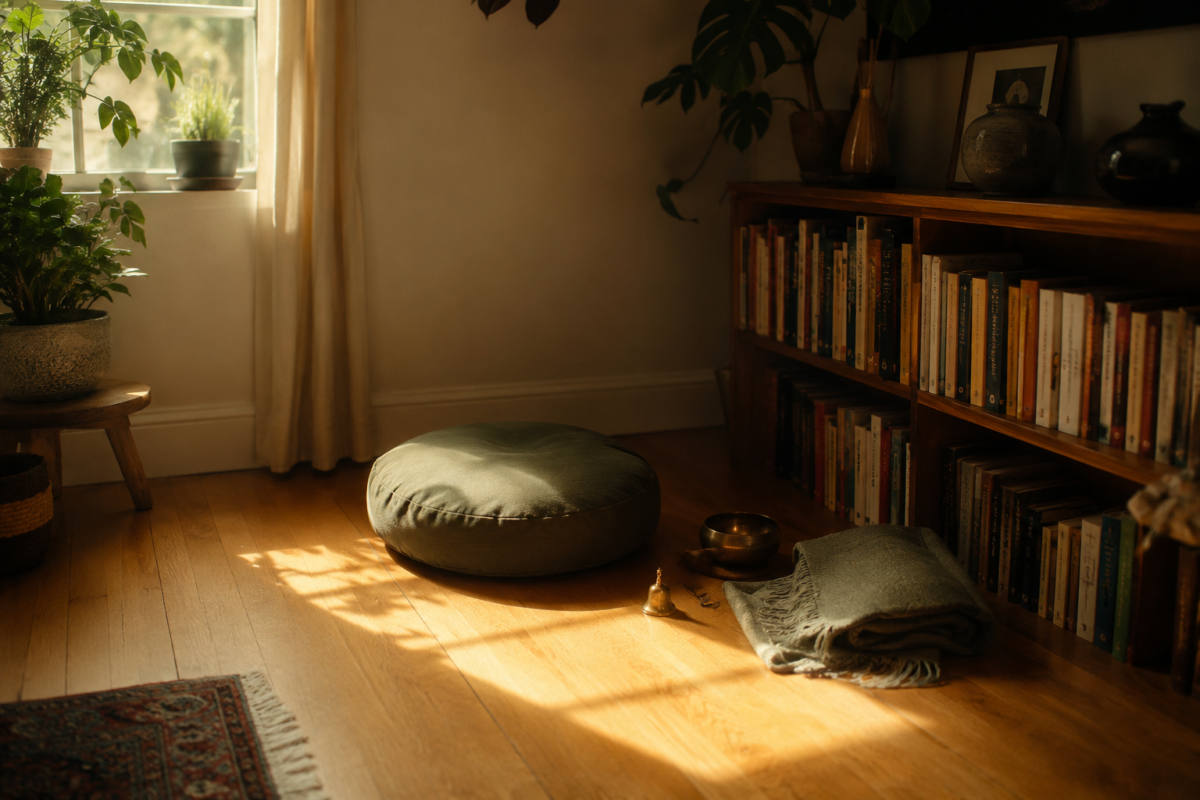
Most meditation practices die of ambiguity rather than difficulty, so the fix is removing every decision from the moment itself.
Write your commitment in this exact shape: After I [existing habit], I will sit in [specific place] and do [specific technique] for [specific minutes]. A real one looks like: “After I pour my first coffee, I will sit on the left end of the sofa and do four minutes of noting.” Compare that with “I’ll meditate more this month.” One is executable at 6:40 a.m. with no willpower involved. The other is a wish.
Three more things that carry disproportionate weight:
- Use one physical location. Same cushion, same chair, same corner. Within about three weeks the location itself starts doing part of the work — you sit down and arousal drops before you’ve begun.
- Mark it on paper. An X on a wall calendar, not an app. The visible chain is the reward, and you want the reward to live outside the device that generates half your anxiety.
- Open with three sighs. Before the timer, take three long exhales. It signals the transition and gets you past the first thirty seconds, which is where most abandoned sessions are abandoned.
And a decision rule for the inevitable bad stretch: if you have missed three days, do not restart at your old length. Drop back to the week-one dose of four minutes for a full week before climbing again. Restarting at fifteen after a lapse fails roughly every time.
“A wandering mind isn’t a failed meditation. Noticing the wandering is the meditation — every return is one repetition, and the reps are what change how fast you recover.”
NaturalKnows
Five Signs It’s Working Before You Ever Feel Calm

Calmness is a terrible progress metric because it fluctuates with sleep, hormones, caffeine and whatever landed in your inbox — these five markers move earlier and are far easier to observe honestly.
- Your recovery time shrinks. The stressor still lands. But the stewing afterwards goes from forty minutes to fifteen. This is usually the first thing to change and the last thing people notice, because nothing dramatic happens — something just stops happening.
- You catch the spiral mid-loop. Early on you realise you’ve been catastrophising twenty minutes in. Later it’s five. Eventually you notice the first rung. That shrinking gap is the entire skill.
- You fall asleep faster. If it used to take forty-five minutes to drop off and now it’s twenty-five, that’s a nervous-system change, not a coincidence.
- Your resting breathing slows. Count your breaths for sixty seconds while sitting quietly, before you start any practice. Most adults sit somewhere around twelve to sixteen. Log it in week one and again in week eight — in the Stanford trial, the slower daytime breathing was one of the clearest physical signatures of benefit.
- Sessions get boring. Genuinely good news. Boredom means arousal has dropped far enough that your system is no longer scanning for threats. Anxious minds do not get bored.
To track this without turning it into another source of pressure: each morning, rate your baseline anxiety from 0 to 10 in one line in a notebook. Never compare single days — compare your seven-day average from week one against week eight. Day-to-day noise is enormous; the eight-week trend is the signal. If you’d rather work with a printable version, the planner in our library has a tracker page built for exactly this, and our roundup of natural remedies for anxiety that actually hold up covers what pairs sensibly alongside it.
Five Mistakes That Quietly Sabotage Meditation for Anxiety Relief
These are the errors intermediate practitioners make — people who’ve been sitting for months and still aren’t getting much back.
Mistake 1: Grading the session by how it felt
A session where you were dragged away by thoughts fifty times and came back fifty-one is a better workout than one where you drifted pleasantly. Judging by in-session comfort trains you to chase relaxation and avoid the reps that build the skill. Grade on one thing only: did you sit down. Everything else is weather.
Mistake 2: Never practising without a voice in your ears
Guided audio is excellent scaffolding and a poor permanent home. If a narrator does the noticing for you, you never build the ability to steady yourself at the school gates, mid-meeting, or at 3 a.m. with no headphones. Start weaning in week five — guided for most of the session, silent for the last two minutes.
Mistake 3: Only meditating when you’re already anxious
Using it purely as an emergency tool means every rep happens under the hardest possible conditions, and the skill never gets built on easy ground. Worse, it becomes another safety behaviour — something you do to anxiety rather than a baseline you maintain. Practise on calm days. That’s what makes it available on bad ones.
Mistake 4: Focusing inward when your body is the trigger
If your anxiety expresses itself as heart-flutters and chest tightness, ten minutes of close attention to your heartbeat is not neutral — it’s exposure without a plan. Anchor externally instead. Most beginner instruction assumes breath-focus is universal, and for a substantial minority of people it is precisely the wrong starting point.
Mistake 5: Changing five things at once
Meditation plus a new supplement plus cold showers plus cutting caffeine plus a journaling practice, all starting Monday. In eight weeks you’ll feel different and have no idea why — so when life gets busy you’ll drop the wrong four things. Add one variable per fortnight. If you also want to explore essential oils for stress and anxiety or adaptogens for stress and focus, start them in week three, not week one.
Questions Readers Ask Us Most
If you’d like to widen the toolkit beyond sitting practice, our overviews of holistic approaches to managing stress, seven ways to calm your nerves naturally and acupressure before public speaking each cover a different angle. The full Natural Mindfulness and Meditation library is worth a browse, and our cornerstone guide to mindfulness and meditation for anxiety is the best place to go deeper on the underlying approach.
Ready to run the full eight weeks?
The Natural Reset Bundle — 10 guides + a 2-year planner
Everything in this article, expanded into printable sessions, trackers and routines — calm, sleep, energy and mindful living in one library. Instant download, lifetime access, yours for $27.
Get instant access →The version of meditation for anxiety relief that works is smaller and duller than the one you’ve been sold: four minutes, one chair, one anchor, most days, for two months. Pick the technique that matches how your anxiety actually shows up, protect the slot rather than the length, and measure how fast you recover instead of how calm you feel. Eight weeks from now, the difference won’t announce itself — you’ll just notice something that used to ruin your afternoon only costs you ten minutes.
EDUCATIONAL CONTENT ONLY
This article is general wellness information published by NaturalKnows and is not medical advice, diagnosis or treatment. Meditation is a supportive lifestyle practice, not a treatment for any medical or psychiatric condition. If anxiety is interfering with your work, relationships or sleep, please speak with a licensed doctor or mental health professional — and never start, stop or change prescribed medication without their guidance. If you are in crisis or worried about your immediate safety, contact your local emergency services or a crisis support line in your country right away.