Quick answer
The best natural sleep aids are habits first: get up at the same time every day, go outside in the morning, stop caffeine by noon, and spend the last hour before bed in dim light with a warm shower and a cup of herbal tea. A regular wake time has the strongest evidence of all.
Key facts
- Strongest evidence: a regular wake time and sleep schedule
- Morning daylight helps set your body clock
- Caffeine: stop by noon
- Last hour: dim light, warm shower, herbal tea
- Long-term insomnia: talk to a doctor
The best natural sleep aids are not pills or potions: they are a regular schedule, morning daylight, a cool dark bedroom and a calm wind-down, with herbal teas, lavender aroma or a warm bath as pleasant extras. In short, habits have the strongest evidence for insomnia, while herbs and supplements show modest, mixed results. However, small comforts can make the habits easier to keep. Therefore, this guide ranks ten options by evidence, gives a seven-night plan, and lists the cautions; we do not sell or recommend supplements.
Ten natural sleep aids, ranked by evidence
| Option | Evidence | Honest note |
|---|---|---|
| Regular wake time and sleep schedule | Strong | The core of insomnia therapy |
| Morning daylight; dim evenings | Strong | Sets the body clock |
| Cool, dark, quiet bedroom | Good | About 16 to 19°C suits most people |
| Daytime exercise | Good | Not within 2 hours of bed, if it wakes you up |
| Warm bath or shower 1 to 2 hours before bed | Moderate | The cool-down afterwards promotes sleepiness |
| Relaxation and slow breathing | Moderate | Helps a busy mind |
| Lavender aroma | Small studies | Low risk; pleasant |
| Herbal teas (chamomile, lemon balm) | Limited | Mostly ritual and warmth |
| Valerian, passionflower | Mixed | Possible drowsiness; interactions |
| Magnesium, melatonin, tart cherry | Mixed to modest | Ask a doctor first |
Consequently, start at the top of the table, and add extras later.
The Natural Calm & Evening Bundle
Calmer mornings, steadier days, easier evenings: 6 natural calm products with a 30-day path that ties them together.
- EbookNatural Calm
- EbookThe Natural Sleep Guide
- EbookMindful Mornings Naturally
- PrintableWind-Down Routine
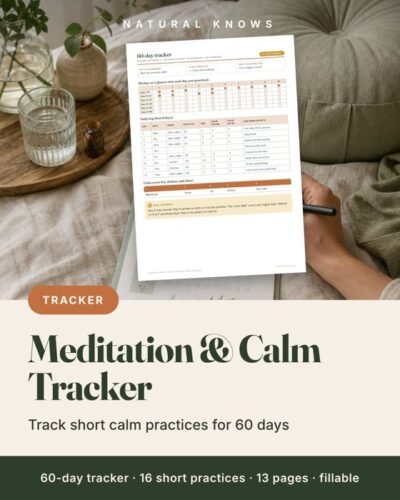
- TrackerMeditation & Calm Tracker
- PrintableBreathing Practice Cards


Habits: the strongest natural sleep aids
- First, fix your wake-up time, seven days a week.
- Next, go to bed only when sleepy.
- Then keep the bed for sleep; if you lie awake for about 20 minutes, get up, and do something quiet.
- After that, avoid long or late naps.
- Finally, give it two to three weeks, because the body clock adjusts slowly.
These steps come from cognitive behavioral therapy for insomnia, which doctors recommend as the first choice for long-term insomnia. Furthermore, our sleep window tool suggests a schedule.

Evening wind-down with natural sleep aids
| Time before bed | What to do |
|---|---|
| 2 hours | Finish dinner; dim the main lights |
| 90 minutes | Warm bath or shower |
| 60 minutes | Screens off; herbal tea |
| 30 minutes | Reading, stretching or slow breathing |
| 0 | Lights out in a cool, dark room |
In addition, the evening calm check shows which step to adjust first.
Recipe: bedtime tea, the gentlest of the natural sleep aids
- 2 teaspoons dried chamomile flowers
- 1 teaspoon dried lemon balm
- 1 cup just-boiled water
First, pour the water over the herbs. Next, cover, and steep for 10 minutes. Then strain, and sip slowly.
Shelf life: drink fresh; store dried herbs for up to 12 months. Safety note: skip chamomile with a daisy-family allergy, and check interactions if you take blood thinners or sedatives.
The National Center for Complementary and Integrative Health notes that evidence on chamomile for insomnia is scarce. Therefore, enjoy the tea for the ritual. See more cups in herbal teas for better sleep.
Lavender and other aromas
Diffuse 4 to 5 drops of lavender for 30 minutes before bed in a ventilated room, or place one drop on a tissue near the pillow. Meanwhile, our guide to essential oils for better sleep and the diffuser blend tool offer more ideas.
Safety note: never swallow essential oils, and keep pets out of the room while diffusing.
Supplements sold as natural sleep aids: the facts
| Supplement | What studies show | Caution |
|---|---|---|
| Melatonin | Helps jet lag and shifted body clocks; small effect on ordinary insomnia | A hormone; quality varies; ask a doctor |
| Magnesium | May help people who are low; mixed otherwise | Kidney disease; interactions |
| Valerian | Inconsistent | Drowsiness; not with sedatives or alcohol |
| Tart cherry juice | Small studies; modest effect | Sugar content |
| Glycine, L-theanine | Small studies | Limited long-term data |
For example, read our guide to magnesium for sleep. Nevertheless, no supplement replaces the habits above.
A 7-night plan with natural sleep aids
| Night | Step to add |
|---|---|
| 1 | Fixed wake time, and morning daylight |
| 2 | No caffeine after noon |
| 3 | Screens off 60 minutes before bed |
| 4 | Warm shower and bedtime tea |
| 5 | Cooler, darker bedroom |
| 6 | 20 minutes of daytime exercise |
| 7 | Five minutes of slow breathing in bed |
What disturbs sleep
- Caffeine within 8 hours of bedtime
- Alcohol, which fragments the second half of the night
- Heavy or spicy late dinners
- Bright screens and work in bed
- Clock-watching; turn the clock away
Who needs medical advice before using natural sleep aids
- Pregnant or breastfeeding women
- People on sedatives, antidepressants, blood thinners or blood pressure medicines
- People with liver, kidney or heart conditions
- Shift workers with ongoing sleep problems
- Children and teenagers
Safety notes on natural sleep aids
See a doctor when insomnia lasts longer than three weeks, or comes with loud snoring, pauses in breathing, restless legs, low mood or daytime sleepiness that affects driving. In addition, do not drive after valerian, passionflower or melatonin until you know how you react.
Keep going
Next, visit the sleep and calm section, and try meditation for anxiety relief for busy minds.
FAQ: natural sleep aids
What are the most effective natural sleep aids?
A fixed wake time, morning light and a calm wind-down. However, they need two to three weeks.
Does melatonin work?
It helps jet lag most. For ordinary insomnia, the effect is small.
Is chamomile tea enough?
It is a pleasant ritual. Still, evidence is limited.
You want to fall asleep earlier. Which change helps most?
Can I combine several aids?
Habits, tea and aroma combine well. Otherwise, avoid mixing sedating herbs.
Does alcohol help sleep?
No. It worsens sleep quality.
When should I see a doctor?
After three weeks of poor sleep, or sooner with breathing pauses.
Natural still needs amounts and care. Patch test new skin products, keep oils and herbs away from small children, and ask a doctor or pharmacist first if you are pregnant, breastfeeding, take medicines or have a health condition.