
You bought the balm, binned the old cleanser, and two weeks later your chin looks worse than it has in years. That’s the exact moment most people quit — either right before things would have settled, or three months after they should have stopped. This guide shows you how to switch to natural skincare without breaking out, using a swap order, a label test that takes ninety seconds, and a calendar you can actually keep. No detox mythology, no white-knuckling through a rash.

Swap one product at a time, roughly every 14 days, starting with your cleanser and finishing with anything exfoliating or scented. Patch test each new product on your inner forearm twice daily for seven to ten days before it touches your face. If you clog easily, stay with oils and butters rated 0–2 on the comedogenic scale. True purging only comes from ingredients that speed cell turnover — so a plain balm that breaks you out is a reaction, not a detox.
The “Skin Detox” Myth That Keeps People Miserable for Three Months
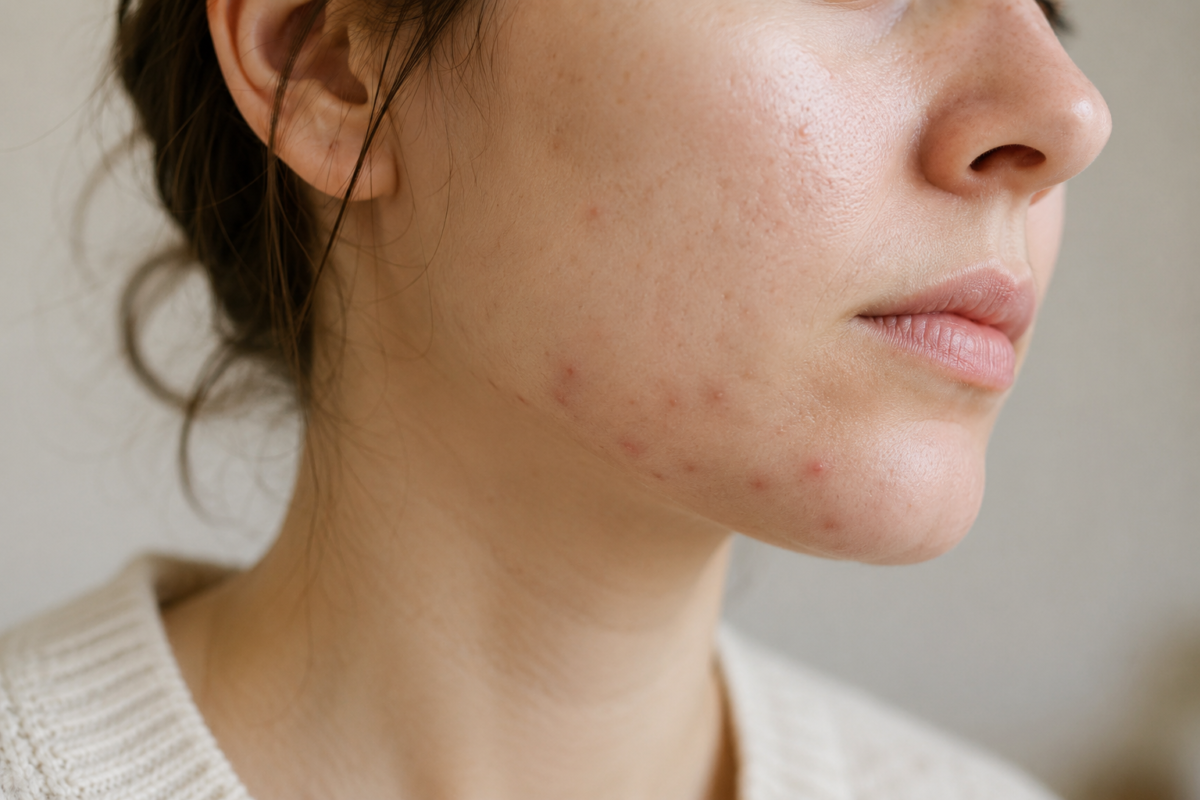
Most advice about the natural-skincare transition gets this backwards: it tells you to push through a breakout, when the breakout is usually the signal to stop. Purging is a real, well-described phenomenon — but it has a specific cause. It happens when an ingredient speeds up how fast your skin sheds and replaces cells, pushing already-forming congestion to the surface faster than it would have arrived on its own. Retinoids, alpha hydroxy acids, beta hydroxy acids and vitamin C do that. A shea and jojoba balm does not.
The timeline is the giveaway. Dermatologists describe purging as starting within roughly the first one to two weeks of a new active and settling by weeks four to six — a window that tracks the skin’s own renewal cycle, commonly cited at around 28 days in younger adults and slower with age. Anything still inflamed at week seven is not a purge that’s running long. It’s something else.
Here’s the nuance nobody mentions: a natural swap can legitimately purge, but only if you’ve introduced a plant-derived active. Willow bark extract contains salicin. Fruit-enzyme and fruit-acid masks behave like mild AHAs. Rosehip oil contains trace naturally occurring retinoic acid. Swap in one of those and a short purge is plausible. Swap in an oat cleanser and a calendula balm and it isn’t.
| Signal | Looks like a purge | Looks like a reaction |
|---|---|---|
| Where it shows up | Your usual zones — chin, forehead, the same two spots | New territory — cheeks, jawline, neck, hairline |
| When it starts | Days 7–14 after the new product | Within 24–72 hours, or newly after week six |
| What you feel | Not much. Maybe slight dryness | Stinging, itch, warmth, tightness |
| Type of bump | Small whiteheads and blackheads surfacing quickly | Red bumps, tiny rough patches, flaking, occasionally hives |
| Trajectory | Worse, then clearly better by weeks 4–6 | Flat or worsening past week six |
| Your move | Hold steady. Add nothing new | Stop the newest product. Return to your last calm routine |
The Slow-Swap Method: How to Switch to Natural Skincare Without Breaking Out
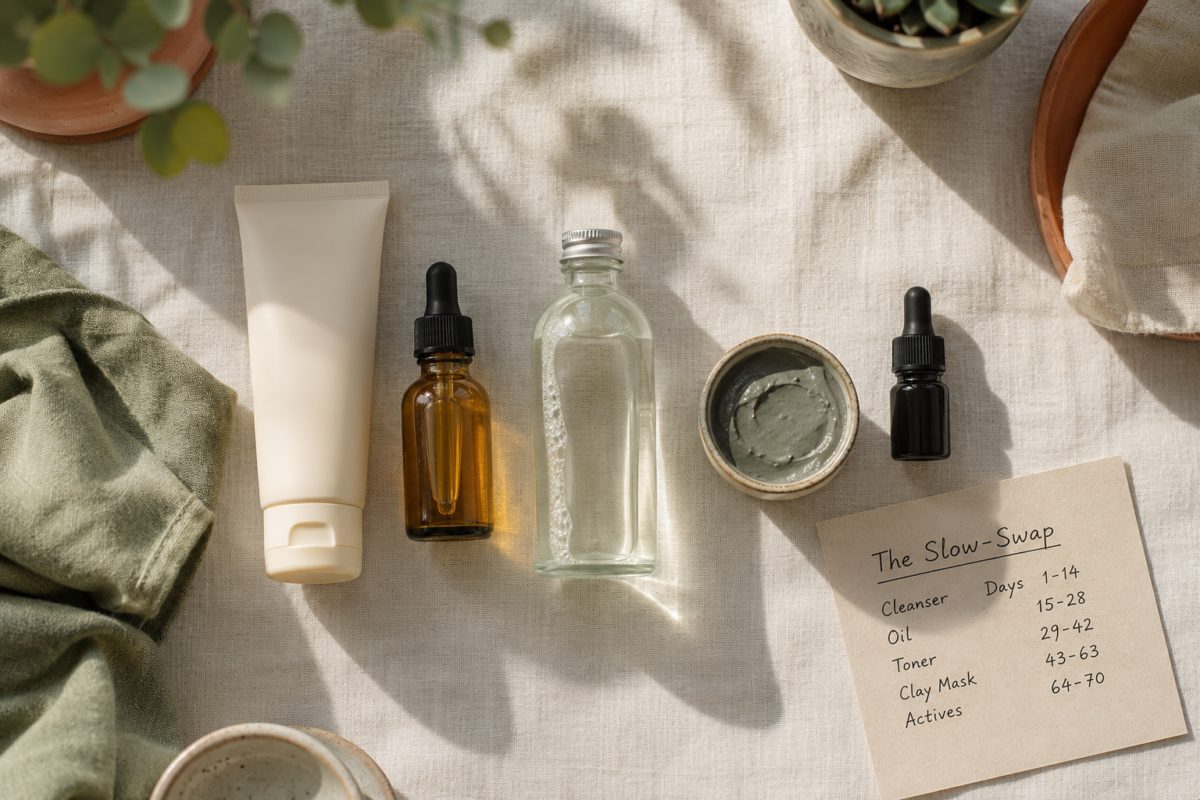
The method is simple — you replace products in order of how much time they spend on your face, from least to most, one every fourteen days. Fourteen days is not arbitrary. It’s long enough for a delayed contact reaction to surface and short enough that you won’t abandon the whole project. Five swaps, ten weeks, one variable at a time.
The Patch Test People Think They’re Doing (and the One That Works)
Dabbing something on the back of your hand for twenty minutes tells you almost nothing, because allergic contact reactions are frequently delayed — they show up on day four, not minute four. The American Academy of Dermatology’s home protocol for testing skin care products is short enough to memorise.
- Pick a quarter-sized spot where the product won’t get rubbed or washed off — the underside of your arm or the crease of your elbow.
- Apply it twice a day for seven to ten days, using the same amount and thickness you’d use normally.
- For anything you’d rinse off, leave it on for five minutes, or however long the label says.
- No redness, itching or swelling after seven to ten days? It’s cleared for your face.
- If you do react, wash it off promptly and don’t go back to it. A cool compress helps settle the area.
Read the Bottle Like a Formulator: Four Label Checks That Take 90 Seconds
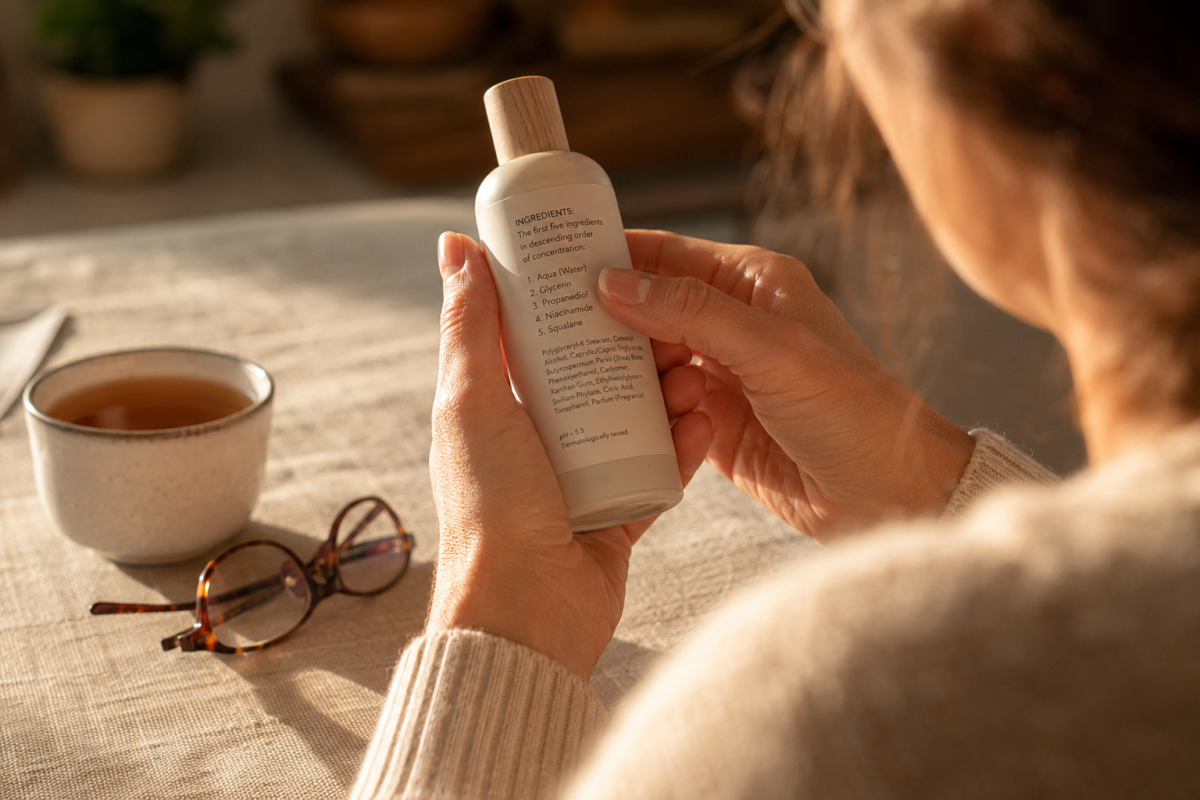
The front of a bottle is marketing; the back is the only part with rules attached. Four checks, in this order, and you’ll filter out most of the products that would have wasted a fortnight of your transition.
Check 1: The First Five Ingredients Are the Product
Ingredients are listed in descending order by weight down to the 1% mark, so the first five are effectively the formula. If your rosehip serum lists rosehip seventh, behind sunflower oil and glycerin, you have bought a rosehip-scented sunflower oil at a rosehip price. That’s not a scandal — sunflower oil is a lovely, barrier-friendly, zero-rated oil — but you should know what you’re paying for and what you’re actually testing on your face.
Check 2: Where the Scent Sits
Whether it’s listed as parfum, fragrance, or a stack of essential oils, position matters. High on the list means a bigger share of the formula and a bigger allergen load. You’ll often see names like linalool, limonene, geraniol and citral on European labels — those are naturally occurring components of lavender, citrus and rose oils that appear frequently in contact-allergy data. Their presence isn’t a red flag by itself. It’s a reason to introduce that product last, when nothing else is a variable.
Check 3: Water Without a Preservative Is a Countdown
If aqua, water, aloe juice or a floral hydrosol appears in the list, that product needs a preservative system — or a very short, clearly stated shelf life and fridge storage. Anhydrous formulas (balms, butters, oil serums, anything with no water at all) are a different story and hold for months. A watery product in an open jar with no preservative and no date is the single most common thing that turns a gentle routine into an irritated one.
Check 4: The Claim Words Mean Less Than You Think
The US Food and Drug Administration states plainly in its fact sheet for small cosmetics businesses that it has not defined “natural” and has no regulatory definition for the term in cosmetic labelling — and it adds that choosing ingredients you consider natural or organic is no guarantee they’re safe. “Clean” has no federal definition either. “Organic” is the one word with teeth, because the USDA’s National Organic Program governs it: a product carrying the USDA seal has to be at least 95% certified organic agricultural ingredients, water and salt excluded.
The Comedogenic Numbers Most Natural Beauty Posts Skip
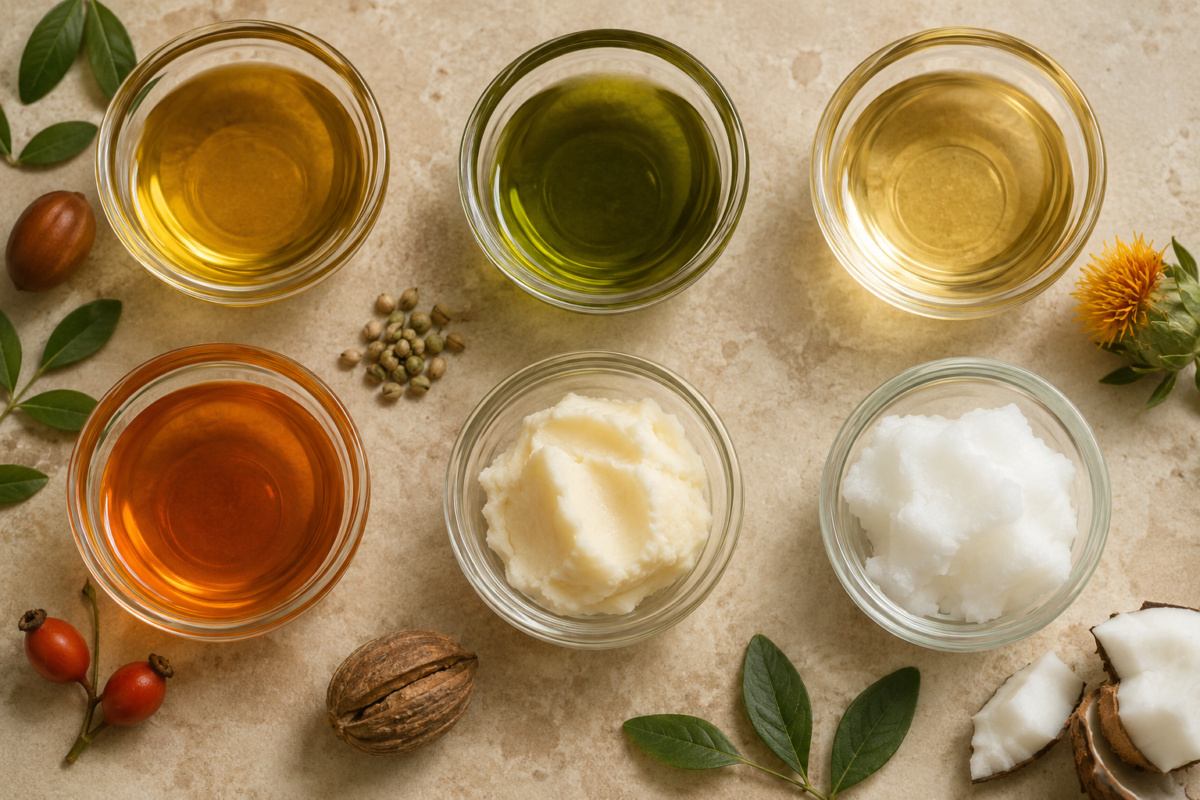
Comedogenic ratings score an ingredient from 0 to 5 on how likely it is to plug a pore, and they explain a huge share of “I switched to natural and broke out” stories. The pattern is almost always the same: someone replaces a light lotion with straight coconut oil, which sits at 4, and blames the transition rather than the ingredient.
| Oil or butter | Rating | Where it earns its place |
|---|---|---|
| Argan | 0 | Face, all types — the safest first oil for a transition |
| Hemp seed | 0 | Oily and congestion-prone skin; high in linoleic acid |
| Safflower & sunflower | 0 | Light daytime oil, barrier-stressed skin, cleansing oils |
| Shea butter | 0–2 | Body and dry cheek patches; skip full-face if you clog easily |
| Rosehip | 1 | Uneven tone and mature skin; oxidises fast, so buy small |
| Calendula-infused oil | 1 | Easily flushed, reactive skin; gentle enough for a first swap |
| Jojoba | 2 | Balanced skin and cleansing-oil bases; technically a wax ester |
| Sweet almond, olive, avocado | 2 | Dry skin, night use, body oils |
| Coconut | 4 | Body, hair, makeup removal that gets rinsed — not left on the face |
| Cocoa butter, palm | 4 | Body balms, lip products, hands and heels |
| Wheat germ | 5 | Keep it off the face entirely |
Now the honest caveat, because you won’t find it in most posts that publish this chart. The 0–5 scale traces back to rabbit-ear testing popularised by James Fulton in the late 1980s, and dermatology reviews have criticised it repeatedly for correlating poorly with human facial skin, for grading isolated raw ingredients rather than finished formulas, and for having no standardised method behind the “non-comedogenic” label. Use the numbers as a shortlist, not a verdict. Your face gets the final say.
One more pattern worth knowing, because it predicts fit better than the ratings alone: oils rich in linoleic acid — hemp, rosehip, grapeseed, safflower, evening primrose — tend to feel lighter and behave better on oil-prone skin, while high-oleic oils like olive, avocado, almond and marula suit drier skin. A 2018 review in the International Journal of Molecular Sciences covering topical plant oils and skin barrier function catalogues how differently these oils behave on the outer skin layer, and it’s a useful reminder that “plant oil” is a category, not an ingredient.
✓ A 21-module planner for 2026 and 2027
✓ Read on any device, or print at home
Your 10-Week Swap Calendar (Screenshot This One)

Here’s the whole plan on one screen, including what to write down and the specific signal that means you pause instead of pressing on.
| Weeks | What changes | What to log | Pause if… |
|---|---|---|---|
| 1–2 | New cleanser. Everything else stays exactly as it was | Tightness after rinsing, on a 1–5 scale | Skin feels squeaky or stings within a minute |
| 3–4 | New moisturiser or facial oil, nights first | Morning shine, any new closed bumps and where | Bumps appear outside your usual zones |
| 5–6 | New toner or hydrosol | Any stinging on application; redness at 10 minutes | Warmth or itch that lasts past ten minutes |
| 7–8 | One weekly mask or gentle exfoliant — once a week | Texture and flaking two days after each use | You feel tempted to use it twice |
| 9–10 | Anything scented or actively botanical | Itch, warmth, small rough patches near the eyes | Any itch at all — this category earns no benefit of the doubt |
How to Switch to Natural Skincare Without Breaking Out When Your Skin Is Already Angry
If you’re reading this mid-flare, the calendar above isn’t where you start. You start by removing variables, then adding them back one at a time — the same logic as an elimination protocol, applied to a bathroom shelf.
For fourteen days, your entire routine is three things: a bland, non-foaming cleanser, one bland moisturiser, and sunscreen in the morning. No oils. No essential oils. No masks, no scrubs, no acids, no facial tools, no new anything. It will feel like you’re doing nothing. Doing nothing is the intervention.
After those two weeks, reintroduce one suspect every fourteen days, easiest first, using the patch-test protocol each time. Most people find their culprit on the second or third reintroduction, and it’s usually either a high-rated oil applied straight or a fragranced product introduced too early.
Four Decision Rules for the Middle of a Flare
- If the bumps are small, closed, in your usual zones and visibly improving by day 21 — then hold everything steady and add nothing new for another fortnight.
- If the bumps have spread past your usual zones — then stop the newest product immediately and go back to the routine you had before it.
- If there’s itch, warmth, or dry rough patches rather than spots — then stop everything scented for fourteen days, including body lotion and laundry products near your pillow.
- If nothing has changed after a full six-week reset — then the trigger probably isn’t on the shelf. Look at your pillowcase, your hair products, your phone screen, hats, helmets and headbands.
The Two-Column Notebook That Finds Your Trigger in 21 Days
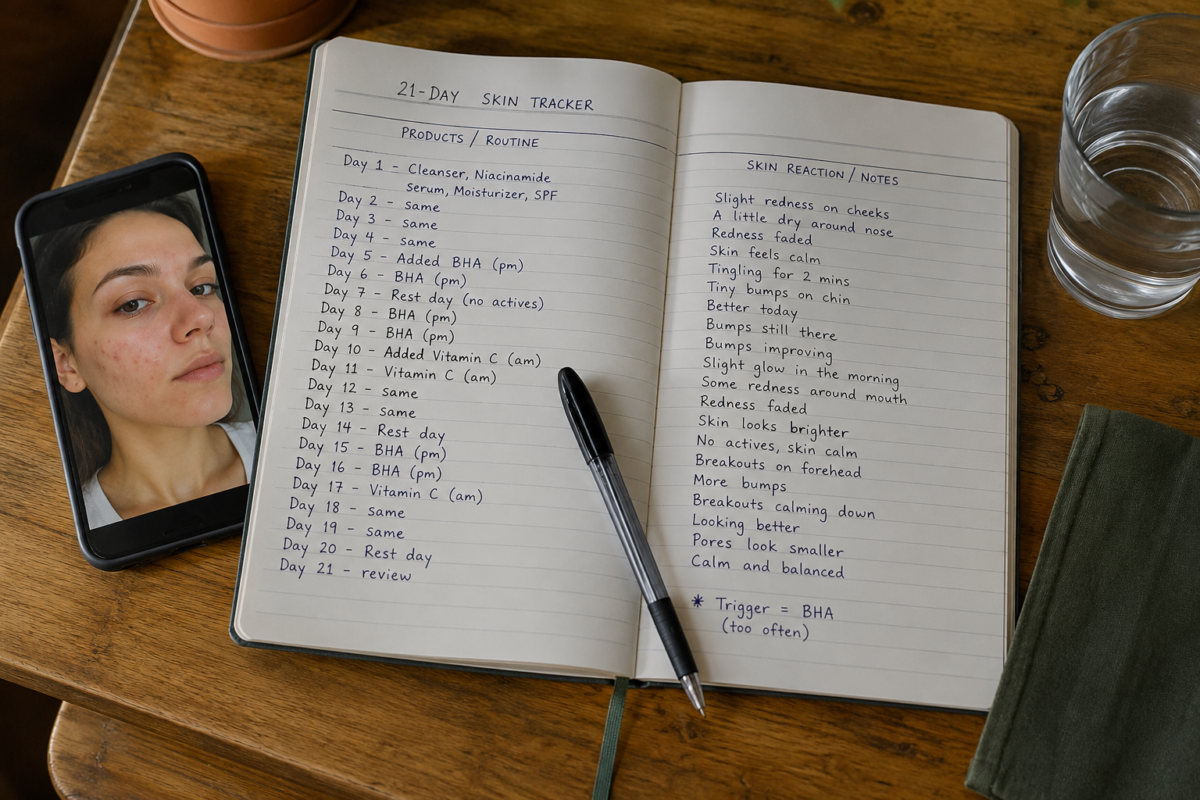
Memory is a terrible instrument for this. You’ll swear a product was fine for three weeks when the log says day nine. So keep the crudest possible record: left column, what went on your face; right column, what your face did.
Write the product name, the step, and the day number of that swap — “argan oil, moisturiser step, day 6” beats “the new oil.” On the right, note anything you’d notice in a mirror: new spots and where, shine by 2pm, tightness, flaking, itch. Add hours slept and, if it’s relevant to you, your cycle day, because both shift skin behaviour enough to muddy a reading.
Then take one photo a week. Same day, same time, same window, no makeup, no filter, phone at arm’s length, natural light on your face rather than behind you. Three of those photos side by side settle arguments your memory can’t. Skin changes too slowly to see day to day and fast enough to see fortnight to fortnight — the camera is the only thing that catches the middle.
The Common Mistakes That Turn a Two-Month Switch Into a Six-Month Mess
These aren’t beginner errors. Every one of them is something a reasonably informed person does while following advice that sounds sensible.
Mistake 1: Starting the Whole Swap With a Facial Oil
It’s the most exciting purchase, so it’s the one people open first. It’s also the product with the longest dwell time on your face and the highest chance of clogging — the worst possible opening move. Start with the cleanser, which is on your skin for sixty seconds and then gone. Save the oil for weeks three and four, once you know your cleanser isn’t the variable.
Mistake 2: Calling a Twenty-Minute Dab a Patch Test
Allergic contact reactions are frequently delayed — that’s their nature, and it’s why formal patch testing in a clinic is read over several days rather than on the spot. Twenty minutes on the back of your hand only catches immediate stinging. Seven to ten days, twice daily, on the inner forearm catches the reactions that actually ruin transitions.
Mistake 3: Throwing Everything Out for a “Clean Start”
It feels decisive and it destroys your ability to learn anything. Five new variables at once, no baseline, no control. Keep your old routine in a box under the sink until the transition is finished. If week four goes sideways, you have somewhere calm to return to while you work out which product did it — and that box is the difference between a two-week detour and a two-month one.
Mistake 4: Using Essential Oils Neat Because They’re “Just Plants”
Undiluted tea tree or lavender dotted onto a spot is one of the most common ways people sensitise their own skin, and sensitisation doesn’t reverse — once your skin has decided it dislikes an ingredient, that decision tends to stick. For facial blends, stay at or below 1%, which works out to roughly one drop of essential oil per two teaspoons of carrier oil. Citrus oils oxidise as they age, and oxidised citrus is more irritating than fresh, so buy small bottles and replace them.
Mistake 5: Adding a Clay Mask to “Pull the Detox Out Faster”
The instinct makes sense and the outcome doesn’t. Clay over an already-stressed barrier increases dryness; dryness prompts more oil; more oil reads as more congestion; you mask again. That loop can run for months. Pause masks entirely for weeks one through six, then reintroduce exactly one, exactly once a week, and judge it on its own.
Questions People Ask Halfway Through the Switch
Now you know how to switch to natural skincare without breaking out: one product every fortnight, one honest patch test, one notebook you’d be embarrassed to show anyone. Give it ten weeks and you’ll come out the other side with a routine you actually understand, rather than a shelf you’re slightly afraid of. The next bottle you buy should have to earn its place — and now you know exactly how to make it prove itself.
✓ Instant download, print-ready
✓ Lifetime access, works on any device
Keep Reading From the NaturalKnows Skincare Shelf
- Start with our cornerstone guide on how to build a completely natural skincare routine for any skin type — it’s the routine this transition plan is designed to get you to.
- Before week nine, read the guide to safe essential oil dilution and storage so your scented step doesn’t undo eight careful weeks.
- If you want the shortest possible version, our simple natural skincare routine is three products and nothing else.
- For the toner step, compare a homemade rosemary water toner with witch hazel in natural skincare.
- When you reach the mask step in weeks seven and eight, our clay mask recipe and complete DIY face mask guide cover the once-a-week version.
- Move the high-rated oils below your neck with our homemade body butter recipe and natural lip balm recipes.
- Curious about body-level habits during the switch? Read the benefits of dry brushing, and browse everything in our Natural Skincare category.